Showing posts with label Livewire. Show all posts

Saturday, December 20, 2008

Livewire Vulcan Modulator DIY Expander

Someone once told me, in reference to their skills with a soldering iron: "..I know just enough to be dangerous.."

I liked that, but in my case its far more appropriate to say: "..I know when I see blue smoke I've done a bad, bad thing.."

Luckily in this case, it all worked out just fine. (for now)
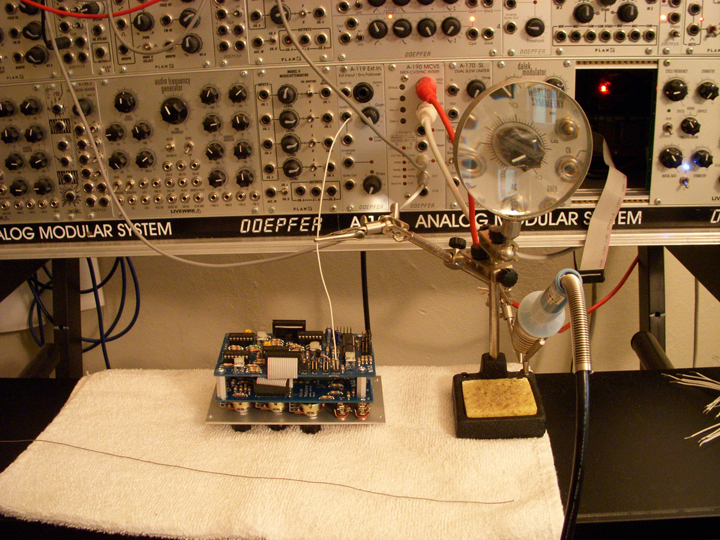

Having owned a Vulcan Modulator since they were first up for grabs @ Analogue Haven back in 2006 I've always appreciated it as a great source for discombobulated modulations and quirky effects. Even using it as two very effective LFOs when the CV inputs are not in use and the attenuators are at zero.
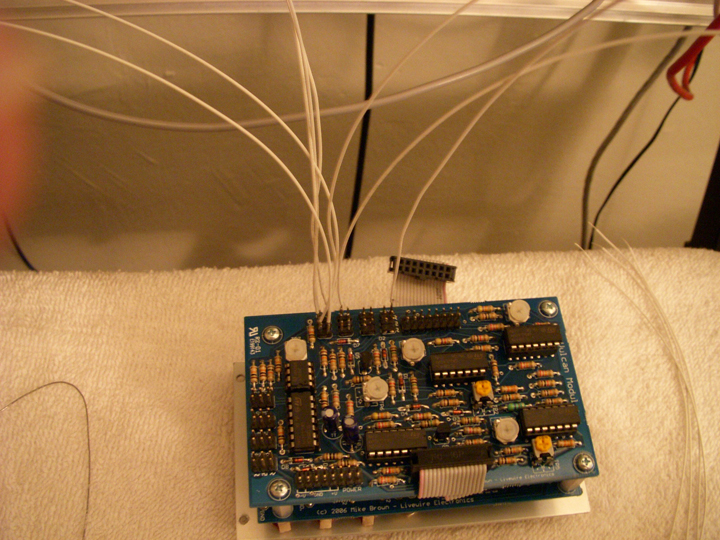


Its greatest feature is of course the Max, Min, Sum & Difference outputs that allow for an even greater palette of choice when it comes to a modulation source. But what I didn't like was having to power down the case, unscrew the module, move the jumpers, place the module back in, power on the case again, let the modules warm back up and THEN see what the combination sounded like. (I never had a long enough power cable to do this procedure  without powering down the case)
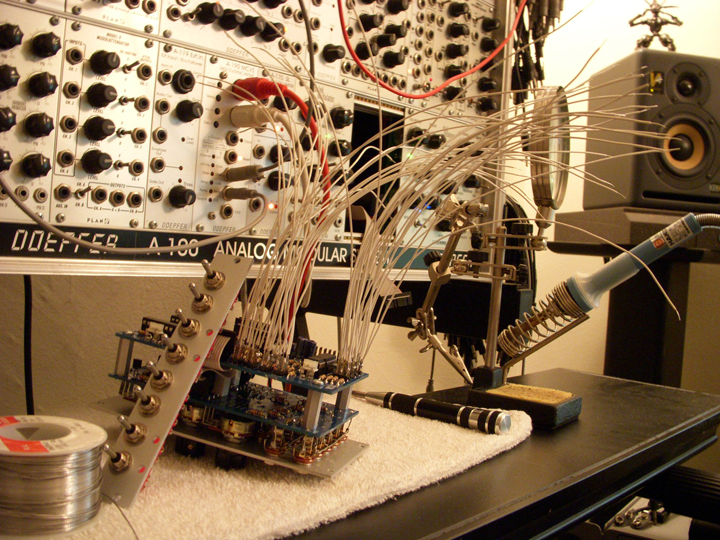


So I took it upon myself to make a small expansion unit to sit beside the Vulcan Modulator that would allow me to switch the waveform mixes around in real time with just the simple option to select either Sine, Triangle or Square waveforms. I remember seeing expanders on either side of one of the Vulcan's Mike Brown had @ NAMM '07. It took some figuring out as to what form factor, what components, etc. to make it possible but it was by no means a very hard task to determine how to do it. The problem laid in connecting all those individual jumper posts without accidently dropping a touch of solder across two making a permanent connection. (had I not known I did it)


As with the Miniwave Euro Kit I spread the task out over a few days so I would lessen my chances of such a screw up. As luck would have it, when the module was placed back in the case and powered on (on a bus board all by its loansome at first, for safety's sake) it lit up and worked like a charm. 
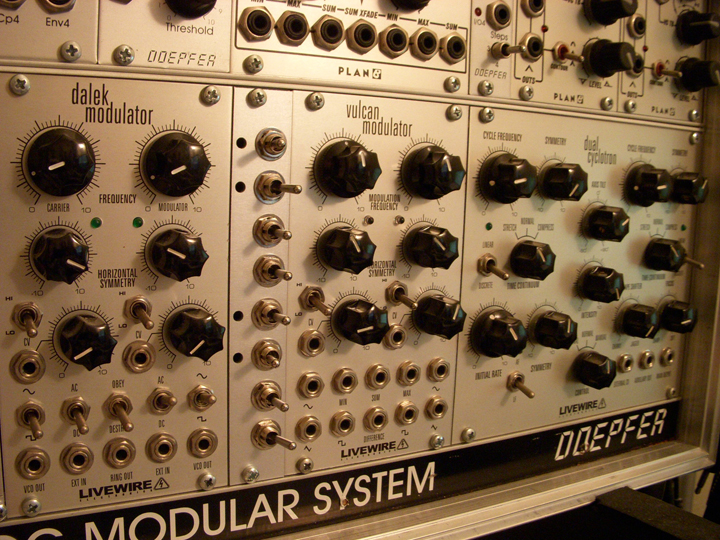


I can now switch the waveforms in real time and have a little more hands on control with the complexity of the modulations to suit whatever mood I find the patch to be going in. Here's a short demo of it working. (warning: TERRIBLE video quality)


I even planned to do a run of simple but up-to-par 4hp faceplates to create kits for others to do that same. But that can not be &  the reasons for it are understandable.  Hopefully soon Livewire will bring out a much better and feature heavy expansion module in the future, I look forward to seeing such a thing.

Saturday, August 9, 2008

Flux Capacitor jumpers, say what?!


Well isn't that neat.

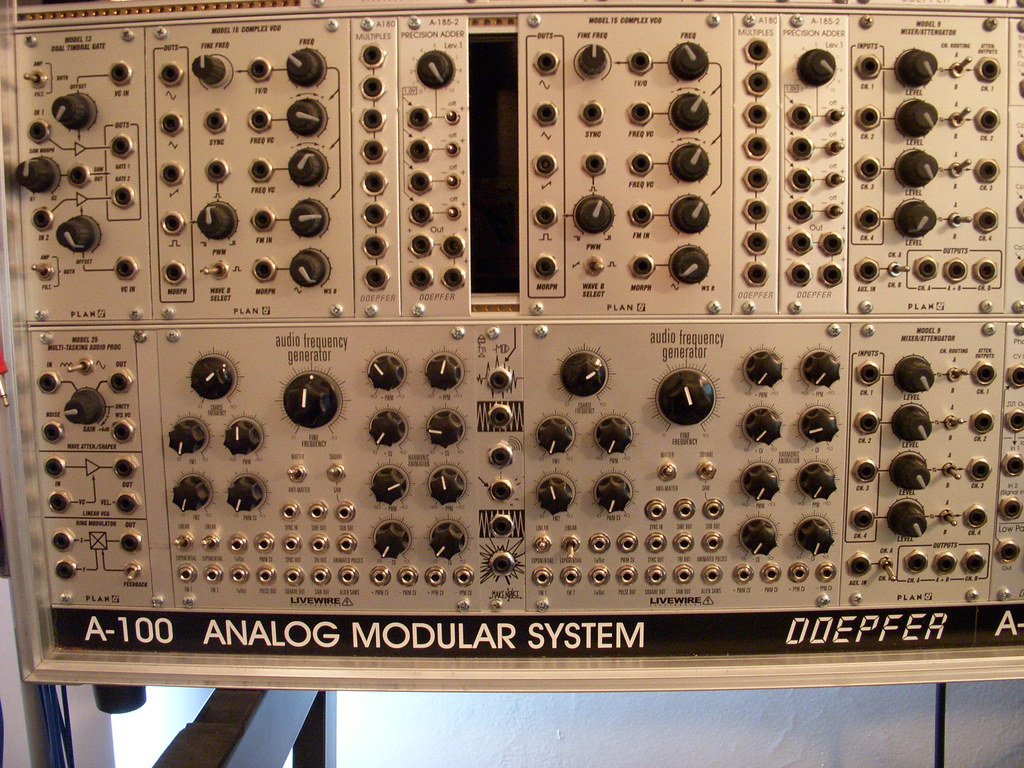
For those of you who obtained an AFG (or several) you'll have not doubt noticed the multiple connection points on the back for the future expansion modules. Regarding this post I'm focusing on the Flux Capacitor pin set. The one with the pair of jumpers located at the top and bottom of the connection point.

These have to do with the resulting ANTI-MATTER waveforms. When you switch from their factory setting of 1&5 you'll obtain different (and sometimes not) versions of the anti-matter setting. 2&5 varied in portions of the cycle minus the square wave. I had little luck with 3&5 and have not yet tried any other combinations.

you can try other combinations yourself and see what you get.  :)


Monday, July 28, 2008

Livewire AFG Easter eggs UPDATE


forgot to check the back of the stacked PCBs.

Clever.

On the solder side of the boards are the following...

animator board = "this will feel a little weird"

main component board = "there is no spoon"

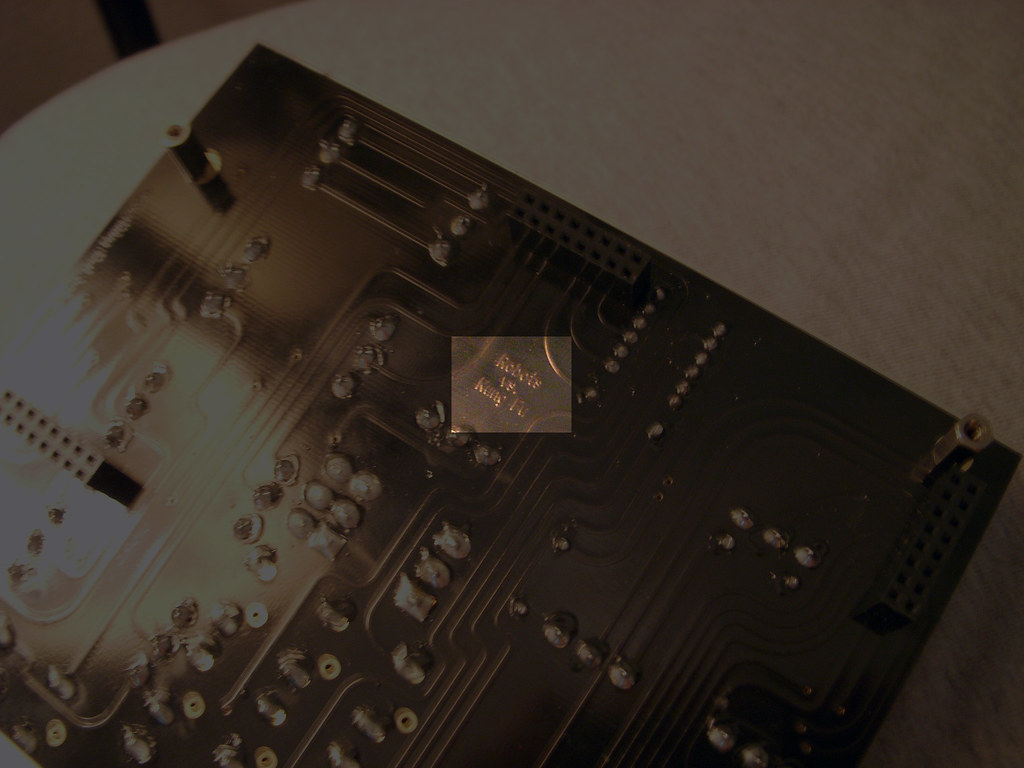
knob & jack board = "the truth is out there",  "everything that has a beginning has an end" & "Robots vs. Kung Fu" (my personal favorite)

:)


Sunday, July 27, 2008

Livewire AFG, Squared.

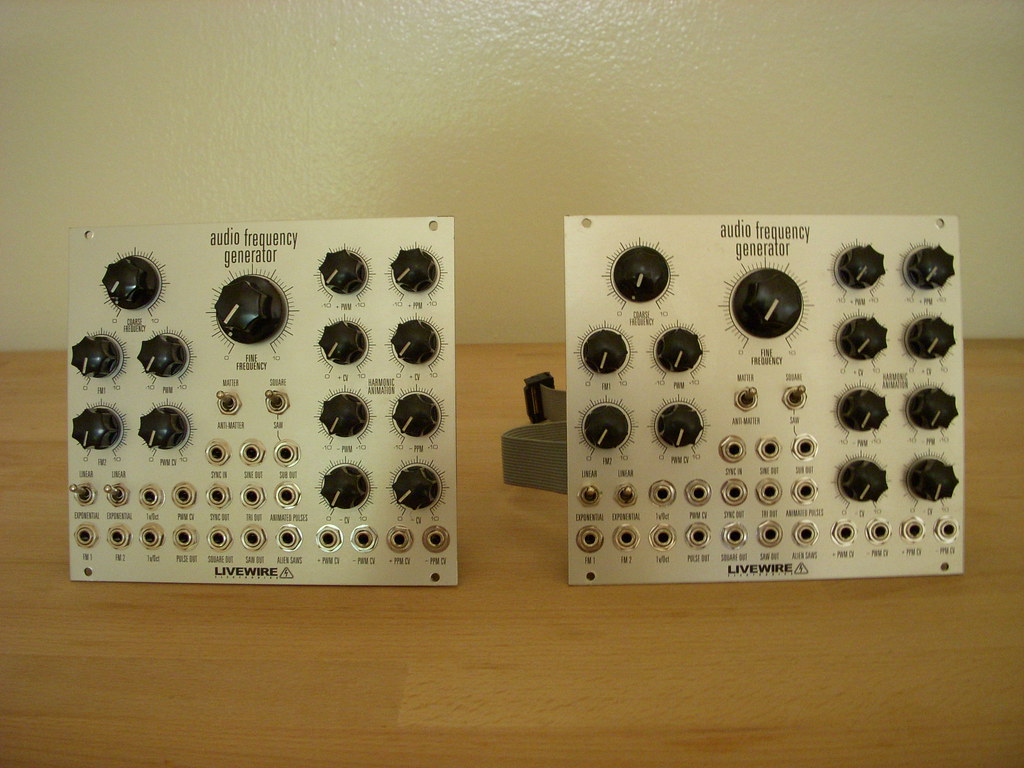
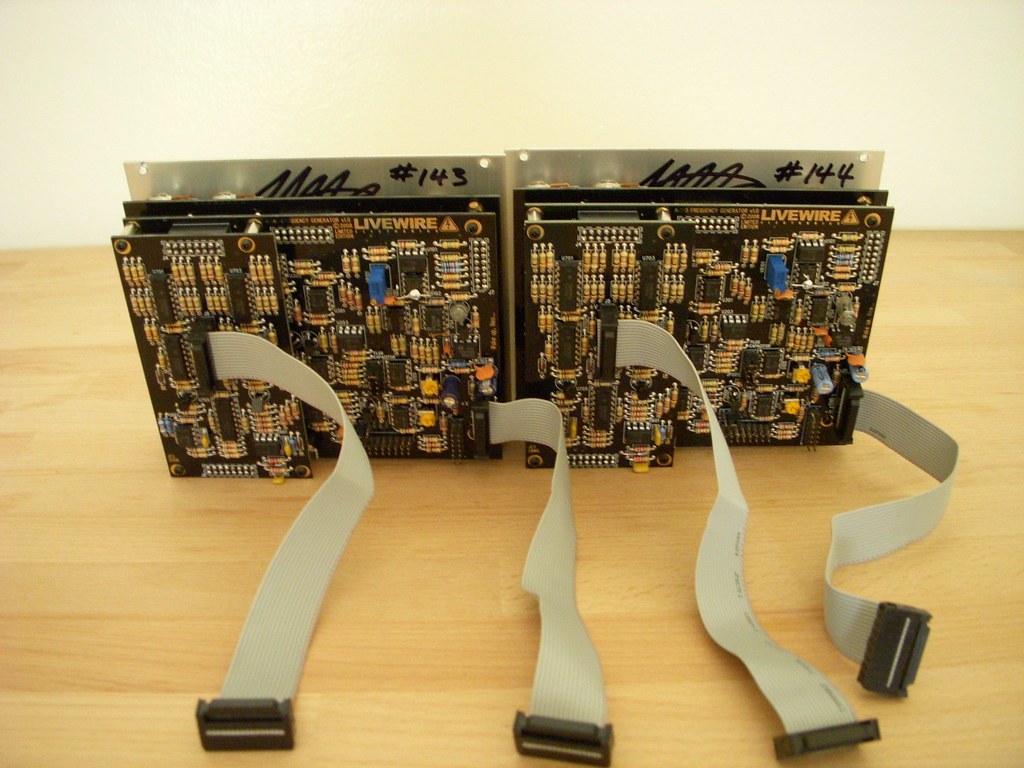
Just took delivery of two Livewire AFGs this evening.


Easter Eggs:

While inspecting the PCBs for hidden treats before installing them I came across lots of quotes from The Matrix. They are as follows...

animator board = "YOU TAKE THE BLUE PILL..." & "YOU TAKE THE RED PILL..."

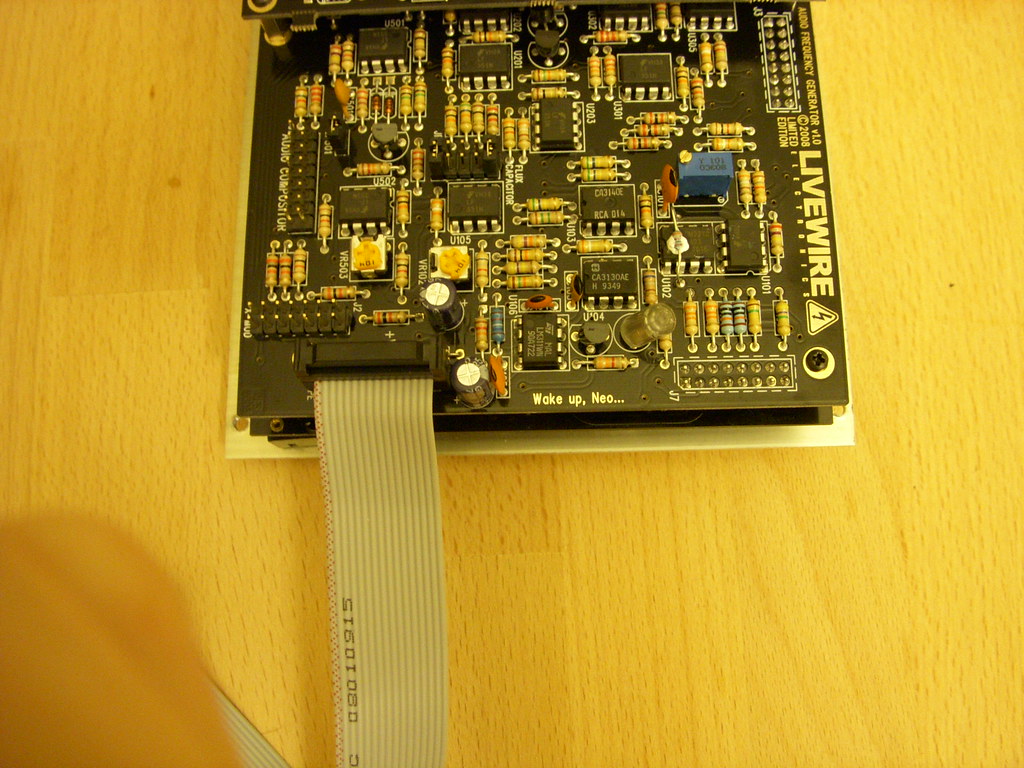
main component board = "Wake up, Neo..." & "welcome to the real world..."

Knob & Jack board = "everything that has a beginning has an end"


I apologize for the lack of pictures for the majority of these, but my less than stellar camera "can't haz macro shots" without the blur.

Tip of The Ice Berg:

I'm having far too much fun exploring the module to do any worthy video demo of the unit. Seeing as how Mike did an amazing job on his own @ Winter NAMM08 for Sonic State I personally see no need. With that said, what I will do is record a simple sequencer showing all four pulse/square outputs one at a time, then all together in the end just to give an example of how thick this one oscillator can get.

Looped Mobius sequence. Square, Pulse, Animated Pulse & Sub Square outs in that order, then all together in the end.

Audio signal chain = AFG -> Frequensteiner -> VCA

Modulation = sine LFO's into pulse & harmonic animator cv inputs. triangle LFO into frequensteiner cv input 1.


Dull, boring, meh. Just an example, nothing more people, the more mundane the process the more I can keep the inkling to wander off and look at shiny things at bay. I'll post worthy examples along with everyone else soon enough.

Lastly:

Everyone who's been waiting so patiently for these will not be disappointed. Mike's team lead by Steve R. were tremendously diligent in working all week to make sure the AFGs get finished. Also note worthy is Analogue Haven's Shawn Cleary & Andrew Felix's dedication to not only shipping out the units as fast as they could safely pack each one for delivery, but also attached knobs to the 20 remaining modules from the delivered sum. They deserve our admiration and respect for putting the time into getting the units finished, with the few exceptions in the end due to quality control. Personally I'd rather it work right, the first time. (But I type this with two units sitting in my system, so I can't speak for everyone or risk the hypocrite banner) Steve did ship them back to Ohio for a speedy turn around before they meet their final destination. So get ready, those in waiting; your time's almost come!


Friday, May 16, 2008

Resonance instability = fun


I was fiddling with the polivoks vcf's resonance this evening and came about a startling setting. Something I can only describe as a sustaining vinyl needle slip.

The only modules in this set up (as shown to the right) are a Livewire Dual Cyclotron -> PlanB Model-15. the Model-15 pulse out -> Polivoks vcf -> Model-13 set fully open (vca-only setting).

The polivoks settings are static, no modulation inserted into the unit of any kind. The input attenuation is at about 60%. Luckily (or not, depending on your opinion) I'd been recording the patch. I brought the cutoff down slowly, once the "needle scratch" is sustained I touched nothing else. The circuit eventually stopped and restarted the oscillation on its own.

It doesn't sound pretty, thats for sure. but we likes it.


Thursday, May 8, 2008

Slacking on the other half.


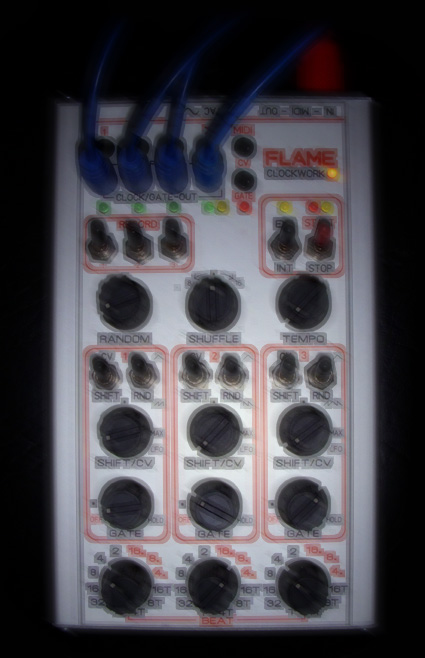
I've been busy this week and haven't had time to write the second half of the review for the Clockwork, but I will get to it, soon.

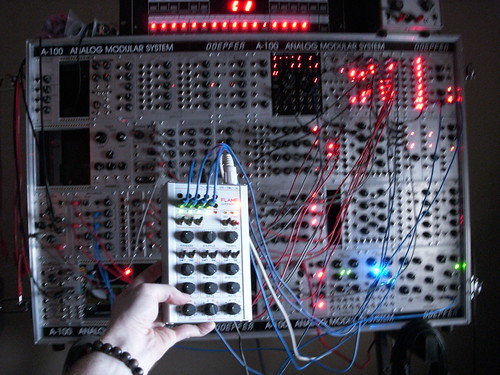
In its stead I have uploaded a short mp3 of a very bland patch that shows how the 3 seperate gate/clock outputs could be used to fire off individual envelopes in a patch. the summed CV/LFO is routed to the 1v/oct input of a Plan B Model-15. the rest of the patch can be seen here. Nothing fancy, just random division assignments that the Clockwork puts into play every downbeat.


I amost forgot, I wouldn't have the opportunity to make this review had Shawn @ Analogue Haven not told me about it. I'd recommend anyone interested in something like this to shoot either Shawn or Andrew over there an email. Good guys those two.

Monday, May 5, 2008

FLAME Clockwork... the first 10 minutes.


ok, so I just de-boxed this guy around 3:00am and have only spent about 15 minutes with it. not nearly long enough for a justified opinion on the whole. BUT, I will say a few things. 1) I plan on a more in-depth post after I get better acquainted with the bugger. 2) It was easy to understand right out of the box without much mucking about with what little manual (more like a one page pamphlet) that comes with the unit. & 3) I'll open her up and see what kind of build quality we are dealing with.

so, until then here is a short little sample of what the patch above sounds like.


Tuesday, April 22, 2008

first post, here goes...

With all the synth related blogs out there why in the hell did I possibly think "hey, one more won't hurt" ?

But seeing as this will likely be lost in the background noise, probably predestined to meander along with the rest of the floating "oh hey, I don't update enough" blogs that clutter the inter-webs I'll not lose sleep over it if that is indeed the case.  

"..so for my first trick" I'll just post a self generating patch I made this evening. nothing fancy or impressive really, mainly something for the overly-eager-to-post commenter to either shift the voltage negative or positive (yes, I'm afriad I really went there.)


your future mockery will be most appreciated.